
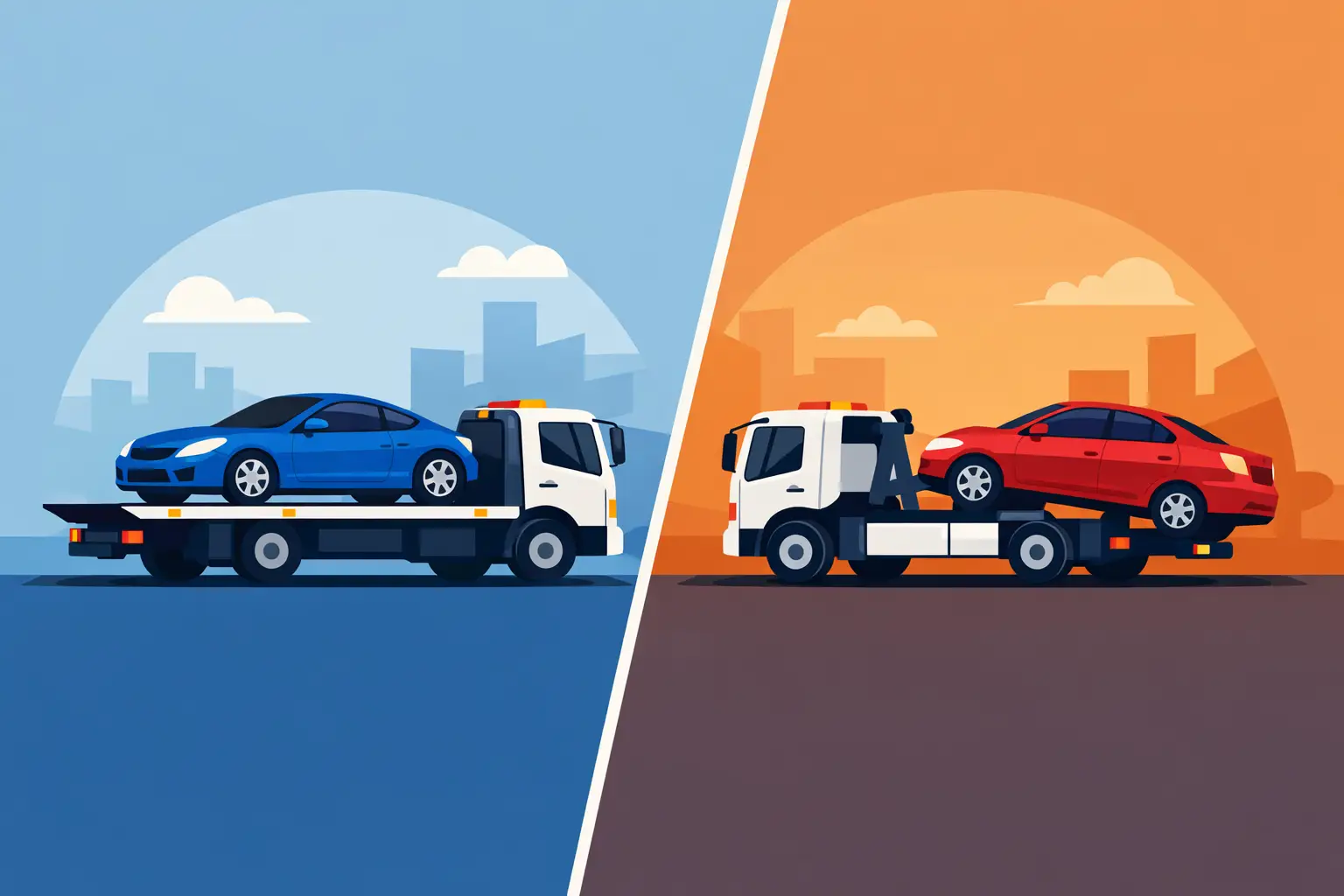
A tow truck is on the way, your car is disabled, and you need it handled right. The flatbed towing vs wheel lift decision can affect your vehicle, your bill, and how safely it reaches the repair shop. Neither method is automatically the best choice every time. The right call depends on what you drive, what failed, where it is sitting, and whether the vehicle can safely roll.
For drivers across Salt Lake Valley, the biggest priority is usually simple: get the vehicle off the road fast without creating a second problem. An experienced tow operator checks the situation before loading up. That matters when you are stuck on I-15, stranded in a parking lot after work, or dealing with a vehicle that will not move after an accident.
What Is Flatbed Towing?
Flatbed towing uses a truck with a long, level deck that tilts and slides toward the ground. Your vehicle is driven or winched onto the platform, secured at multiple points, and carried with all four wheels off the pavement.
Because the whole vehicle rides on the bed, flatbed towing is often the safest choice for all-wheel-drive vehicles, four-wheel-drive vehicles, electric vehicles, luxury cars, and cars with significant damage. It also makes sense when a vehicle cannot be driven, has a locked wheel, has steering damage, or has a mechanical problem that could worsen if the wheels keep turning.
A flatbed gives the operator more control over the load. Your vehicle is not rolling behind the tow truck, which reduces wear on tires, wheel bearings, drivetrain parts, and suspension components during the trip. That extra protection is why many vehicle manufacturers recommend a flatbed for specific models.
When a flatbed is the clear choice
A flatbed is usually the better option after a collision, especially if a wheel is bent, an axle is damaged, a tire is flat, or the steering will not track straight. Pulling a damaged vehicle on its own wheels can be risky for the vehicle and everyone around it.
It is also the preferred method for AWD and many 4WD vehicles. These systems are designed to have all wheels working together. Letting only two wheels roll during a tow can put stress on the drivetrain unless the manufacturer specifically approves that procedure. A flatbed avoids the question entirely.
Low-clearance cars, modified vehicles, classic cars, and vehicles with an unknown mechanical issue often belong on a flatbed too. A careful operator can use the right loading angle, ramps, and securement points to prevent unnecessary scraping or strain.
What Is Wheel Lift Towing?
Wheel lift towing uses a hydraulic metal yoke that slides under either the front or rear tires. The tow truck lifts one end of the vehicle while the other two wheels stay on the road. It is a modern version of the older hook-and-chain approach, but it supports the tires rather than attaching chains directly to the frame or axle.
Wheel lift towing is fast, practical, and often a cost-effective choice for shorter tows. It works well when the vehicle has accessible wheels, the undamaged end can roll freely, and the vehicle’s drivetrain allows it to be towed with one axle raised.
For example, a front-wheel-drive car can often be wheel-lift towed with its front wheels raised. Since the drive wheels are off the ground, the rear wheels simply roll behind the truck. A rear-wheel-drive vehicle may be towed with its rear wheels lifted, provided the condition of the vehicle and manufacturer guidance allow it.
Where wheel lift towing works best
Wheel lift trucks can be especially useful in tight spaces. Think of a crowded apartment lot, a narrow downtown street, a packed shopping center, or a garage entrance where a larger flatbed cannot easily position itself. The operator can hook up quickly and clear a blocked lane without needing as much room to load a vehicle onto a deck.
It can also be a sensible option for a straightforward local tow. If your sedan has a dead battery, will not start, and needs to go a few miles to a trusted shop, a wheel lift may be all that is needed. It is efficient, secure when done correctly, and often gets you moving sooner.
That said, a quick tow should never mean a careless tow. The operator still needs to confirm the transmission type, vehicle condition, towing points, wheel clearance, and whether the remaining wheels are safe to roll.
Flatbed Towing vs Wheel Lift: The Real Differences
The main difference is simple. A flatbed carries your entire vehicle. A wheel lift pulls the vehicle with two wheels on the road. From there, the best option comes down to protection, access, cost, and vehicle compatibility.
Flatbed towing offers more all-around protection because nothing on your vehicle rolls during transport. It is often better for longer distances, serious breakdowns, accident recovery, specialty vehicles, and anything with AWD or 4WD. The trade-off is that flatbeds need more room to load, and they can sometimes take longer to position in a cramped location.
Wheel lift towing is generally quicker to hook up in tight spaces and can be more affordable for a simple local tow. But it is not right for every drivetrain or every type of damage. If the wrong axle stays on the ground, or if the rolling wheels are damaged, the tow can cause avoidable trouble.
Price can vary by distance, time of day, location, vehicle size, and recovery difficulty. Do not choose a towing method based on price alone when your vehicle needs extra protection. A lower upfront cost is not a bargain if it leads to drivetrain or body damage later.
How a Tow Operator Chooses the Right Method
A professional does not guess. Before towing, the operator should look at the vehicle’s drive configuration, whether the tires turn and roll, the condition of the suspension and steering, ground clearance, and the pickup location.
Vehicle owner manuals are useful here because towing instructions differ by make and model. Some vehicles require a flatbed. Others can be wheel-lift towed only when the drive wheels are raised or after specific steps are taken. Electric vehicles need special attention as well. Their weight, battery placement, and manufacturer towing procedures can make flatbed transport the safer route.
The vehicle’s position matters just as much. A car sitting normally in an open lot is very different from a car nose-first against a curb, stuck in a ditch, or stopped at an angle after a crash. In those situations, recovery equipment, dollies, or a flatbed may be needed to move the vehicle without dragging it.
Weather also changes the job. Snow, ice, rain, and Utah’s winter road conditions can reduce traction and visibility. A tow operator needs to secure the vehicle correctly, protect the scene, and choose equipment that keeps the load stable from pickup through drop-off.
What You Should Tell the Tow Company
When you call for a tow, give the dispatcher the facts that help them send the right truck the first time. Mention your vehicle’s year, make, and model; whether it is AWD, 4WD, front-wheel drive, or rear-wheel drive; and whether it has been in an accident. Explain if a tire is flat, a wheel is locked, the steering is damaged, or the vehicle is parked somewhere tight.
Also say where the vehicle needs to go and whether you have a preferred repair shop. If you are unsure about the drivetrain, do not worry. Tell the dispatcher what you know, and the tow team can verify the details. Honest information prevents delays and helps avoid sending equipment that does not fit the job.
If you are waiting on a busy road, get yourself to a safe place away from traffic when possible. Turn on hazard lights, stay aware of passing vehicles, and do not try to push a disabled car through traffic unless it is immediately necessary for safety.
Get the Tow That Fits Your Vehicle
Flatbed towing is often the safest answer when the vehicle is damaged, all-wheel drive, low to the ground, or headed a long distance. Wheel lift towing can be the smart, efficient choice for compatible vehicles and quick local moves. The method should fit the vehicle, not just the nearest available truck.
Munnster Towing provides 24/7 towing and roadside help throughout the Salt Lake Valley, with experienced operators who assess the situation before moving your vehicle. If your car is disabled, explain what happened, where you are, and what you drive. The right equipment and a fast response can turn a stressful roadside stop into a problem that is handled.
continue reading
Related Posts
Learn how to identify battery failure before a no-start turns into a roadside problem. Spot warning signs, test safely, and know when to call for help.
Need overnight tow truck availability in Salt Lake Valley? Get fast, affordable help for breakdowns, lockouts, dead batteries, accidents, and more tonight.
Learn how to prepare for a winter breakdown in Salt Lake Valley: check your car, pack supplies, and stay safe while roadside help is on the way all winter.